



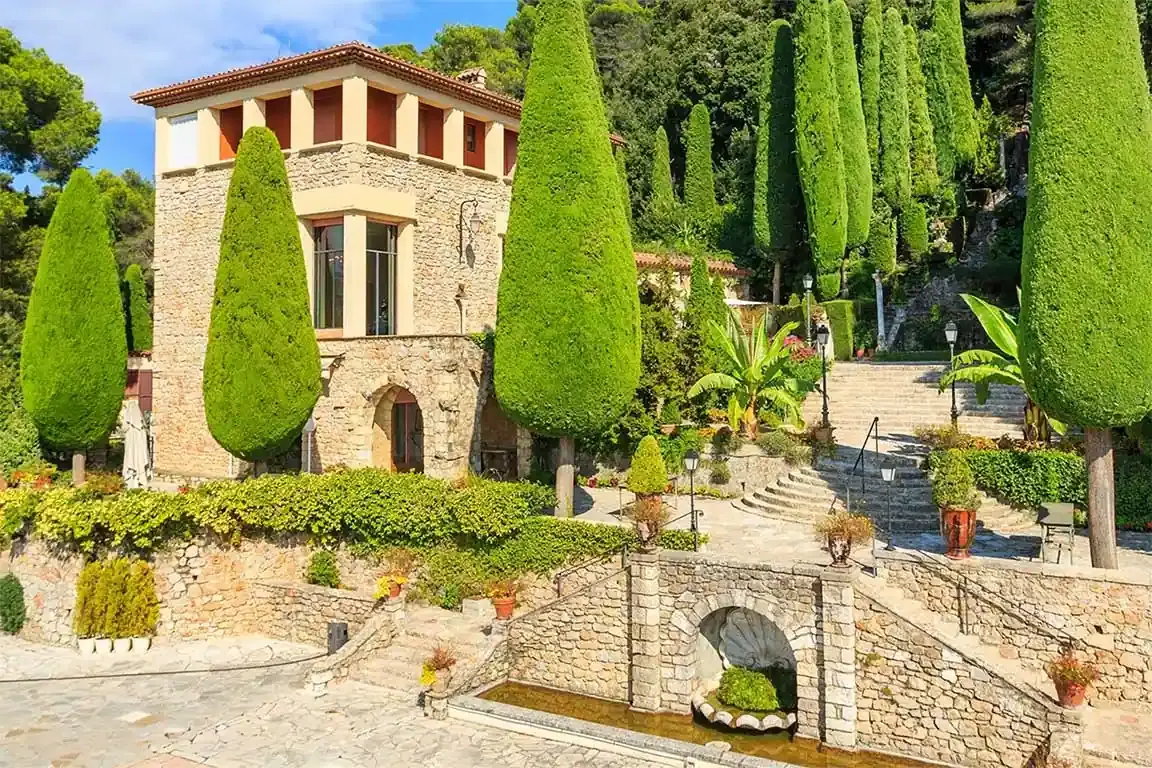
Inspired by Italian Renaissance villas, the property combines architecture, interior decoration, and terraced gardens. Cascades, pools, cypress trees, sculptures, and views over the Bay of Cannes create a setting designed as the natural extension of the artist’s home and studio.
The history of this magnificent villa in Cannes is also linked to the early days of the Cannes Film Festival. Jean-Gabriel Domergue created the poster for the first edition, scheduled in 1939 and ultimately canceled due to the outbreak of World War II. Bequeathed to the City of Cannes in 1973 and listed as a historic monument since 1990, Villa Domergue now hosts tours, exhibitions, and cultural events.
The history of the villa is also linked to the early days of the Cannes Film Festival. Jean-Gabriel Domergue created the poster for the first edition, scheduled in 1939 and ultimately interrupted by the outbreak of World War II. Bequeathed to the City of Cannes in 1973 and listed as a historic monument since 1990, Villa Domergue now hosts tours, exhibitions, and cultural events.
Discover our luxury villas for sale in Cannes
From Villa Fiesole to Villa Domergue
The history of the property began in the late 1920s, when Jean-Gabriel Domergue chose a plot on the heights of Cannes to establish his residence and studio. The house was then known as Villa Fiesole, a reference to the Tuscan town overlooking Florence, whose villas and gardens greatly inspired the painter’s imagination.
Construction is documented in 1929 and attributed to the associated architects Émile Molinié and Charles Nicod. However, Jean-Gabriel Domergue was directly involved in the overall design of the house, the choice of its décor, and the layout of the spaces. He did not simply want a comfortable home, but to create an environment entirely devoted to artistic life, entertaining, and contemplation of the landscape.
Work and landscaping continued in the following years. The gardens were notably developed between 1934 and 1936, while a caretaker’s house was rebuilt in 1936. Villa Fiesole gradually took shape as a true artist’s estate, where architecture, sculpture, vegetation, and decorative arts are in constant dialogue.
A residence designed for an artist couple
Jean-Gabriel Domergue was then a recognized painter, particularly famous for his portraits of elegant women and for his posters. His wife, Odette Domergue, fully contributed to the artistic identity of the property. A sculptor, she created several works intended for the gardens and helped make the villa a shared creation.
The house had to meet different uses. It was at once a private residence, a studio, a reception venue, and a space for display. The Domergues welcomed figures from the worlds of art, culture, and Cannes society there, in a carefully staged setting.
After Jean-Gabriel Domergue’s death in 1962, Odette preserved the property and for several years arranged a space devoted to her husband’s work. She ultimately bequeathed the villa and its gardens to the City of Cannes in 1973, ensuring the preservation of this remarkable ensemble.
An architecture inspired by Italian villas
Villa Domergue stands out for its architecture freely inspired by the great Italian houses of the Renaissance. Its placement on a sloping site, asymmetrical volumes, tiled roofs, and stone façades create a silhouette that is both monumental and intimately tied to the Mediterranean landscape.
The house does not seek to faithfully reproduce a historical model. Instead, it offers a personal interpretation of Italian architecture, adapted to the couple’s lifestyle and to the topography of the hills above Cannes.
Volumes organized around the studio
The property comprises a basement level, a ground floor, and an upper floor. The north wing ends in an apse-like section, lit by tall openings and occupied by Jean-Gabriel Domergue’s studio.
This studio is one of the villa’s key spaces. The height of the openings allows natural light to enter, essential for the painter’s work. The room is integrated into the house while retaining a distinct identity, suited to creation and the display of artworks.
From the arrival courtyard, a porch marked by round arches provides access to the house. Terraces, stairways, and exterior passageways multiply the connections between the interior spaces and the garden. Movement is not limited to a succession of rooms: it naturally extends to the patios, pools, and different levels of the grounds.
A décor conceived down to the smallest detail
Jean-Gabriel Domergue paid particular attention to interior decoration. Furniture, objects, paintings, and architectural elements were chosen to form a coherent whole, reflecting his taste for Italy, the decorative arts, and staging.
The living room, entrance, and reception areas bear witness to this search for harmony. The décor is not conceived as a mere complement to the architecture: it fully contributes to the identity of the house and to the atmosphere the Domergues wanted to offer their guests.
The terraced gardens of Villa Domergue
The gardens are one of the property’s most remarkable features. Spread over roughly one and a half hectares, they make use of the natural slope of the hill to create a succession of terraces, perspectives, and spaces with different atmospheres.
Jean-Gabriel Domergue drew inspiration from Italian Renaissance gardens, notably those of Villa Gamberaia near Florence and Villa Farnese in Caprarola. He nevertheless adapted these references to the vegetation and light of the French Riviera.
A stage set of water and vegetation
A winding cypress-lined avenue leads visitors to the arrival courtyard. Around the villa, the terraces are arranged along a principal axis crossing the garden. It descends from the areas devoted to aromatic plants to the reflecting pool, passing a cascade and several basins.
Water occupies a central place in the composition
Cascades, fountains and mirrors create plays of light and accompany the progression through the estate. Columns, sculptures, obelisks and architectural fragments punctuate the views and accentuate the ensemble’s Italian inspiration. The vegetation combines clipped cypresses, isolated trees, flowering beds, borders and wooded areas. This diversity makes it possible to create, in succession, open areas onto the landscape and more intimate spaces, sheltered by vegetation.
Odette Domergue’s sculptures
The garden also bears Odette Domergue’s mark. Several sculptures line the pathways and terraces, including representations of the four seasons installed in a hemicycle. The sculptor also created the couple’s funerary effigies, inspired by Etruscan art and in particular the tombs of Cerveteri.
These figures adorn the tomb of Jean-Gabriel and Odette Domergue, set in an artificial grotto in the garden. In accordance with their wishes, their remains, initially buried in the Grand Jas cemetery, were later transferred to the property.
The garden thus takes on a more personal dimension: it becomes both a landscape work, a place of remembrance, and the final resting place of the couple who envisioned it.
Jean-Gabriel Domergue and the birth of the Cannes Film Festival
Jean-Gabriel Domergue’s name is sometimes wrongly associated with the founding of the Cannes Film Festival. His historical role was different, but nevertheless important: he was chosen to create the official poster for the first International Film Festival, whose opening was scheduled for September 1939. This event was meant to allow France to offer an alternative to the Venice Film Festival and to assert Cannes’s international standing.
The local organizing committee entrusted Domergue with designing a poster intended to promote the event in France and abroad.
A first edition interrupted by war At the end of August 1939, the first guests, artists, members of the press and film personalities began arriving in Cannes. The city was preparing numerous receptions and getting ready to host an event destined to become one of the major international cultural gatherings. However, the outbreak of the Second World War brought the project to an end. Germany’s invasion of Poland, followed by the declarations of war by France and the United Kingdom, led to the postponement and then the cancellation of the event. The poster created by Jean-Gabriel Domergue thus remains a witness to an initial attempt cut short. The Cannes Film Festival would not see its true first edition until 1946, but the artist’s involvement in the 1939 event firmly inscribed his name in the early history of Cannes cinema. ## The Villa Domergue today Becoming property of the City of Cannes in 1973, Villa Domergue is today a heritage and cultural site. The house and its gardens were listed as historic monuments in 1990, a recognition that notably covers the garden ornaments, sculptures and the various landscape features of the estate. The villa is managed by Cannes’s Contemporary Art Center. It occasionally hosts guided tours, temporary exhibitions and events organized by the City. Public access remains regulated, which helps preserve the intimate character of the property and the fragility of its decor. The interior spaces allow visitors to discover the studio, the salon, the entrance and several rooms that bear witness to the artistic world of the Domergues. Outside, visitors walk through the terraces, stairways, basins and gardens that form an essential part of the site’s identity. ## An artistic heritage emblematic of Cannes Villa Domergue holds a special place among Cannes’s historic residences. Its appeal lies not only in its architecture or gardens, but in the coherence of the whole envisioned by Jean-Gabriel and Odette Domergue. House, studio, sculptures and landscape composition form a total work, deeply marked by Italian references and by the art of living on the French Riviera during the interwar period. The bequest made to the City of Cannes made it possible to preserve this testimony to Cannes’s artistic life and pass it on to future generations. In the image of the Pavillon de Flore, Villa Rothschild or the great estates of La Californie, Villa Domergue recalls the importance of artists’ homes in shaping Cannes’s cultural identity. These houses are not mere settings: they tell the story of the personalities who lived in them, the works created there and the long-standing relationship between the city, the arts and architecture. Heritage enthusiasts can also discover our collection of Belle Époque villas for sale, bringing together historic residences and character properties on the French Riviera and in France’s major vacation destinations.

A lire aussi