



Henry Jacques Le Même, the architect who shaped Megève’s identity
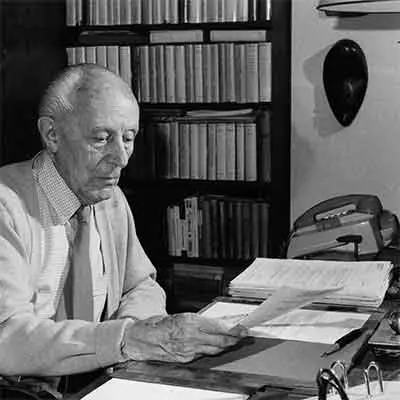
Based in Megève from 1925 onward, Henry Jacques Le Même did not simply reproduce the traditional farms of Haute-Savoie. He imagined a new form of mountain residence, suited to winter sports, holiday living, and the expectations of a clientele seeking comfort and refinement. Nearly a century later, his work continues to influence the architecture and real estate market of the resort.
From Nantes to the Alps: the making of a modern architect
Born in Nantes in 1897, Henry Jacques Le Même first studied at the Regional School of Fine Arts in his hometown. He then joined the École nationale supérieure des Beaux-Arts in Paris, where he received a classical architectural education under Emmanuel Pontremoli.
In 1923, he won the Rougevin ornament competition. His work caught the attention of the decorator and interior designer Émile-Jacques Ruhlmann, a major figure of Art Deco, who brought him into his workshop. This Parisian experience, between 1923 and 1925, left a lasting mark on the way he conceived buildings: architecture, decoration, furniture, and the smallest details were all meant to form a coherent whole.
At the same time, the young architect developed an interest in modern movements, particularly the ideas of Le Corbusier and the Dutch De Stijl movement. His later work would be neither strictly modernist nor simply regionalist. It would be based on a constant dialogue between contemporary uses, the characteristics of the site, and local building traditions.
Arrival in Megève and the meeting with Noémie de Rothschild
At the end of 1925, Henry Jacques Le Même left Paris and settled in Megève. The ski resort was then developing rapidly, notably under the influence of the Rothschild family at Mont d’Arbois.
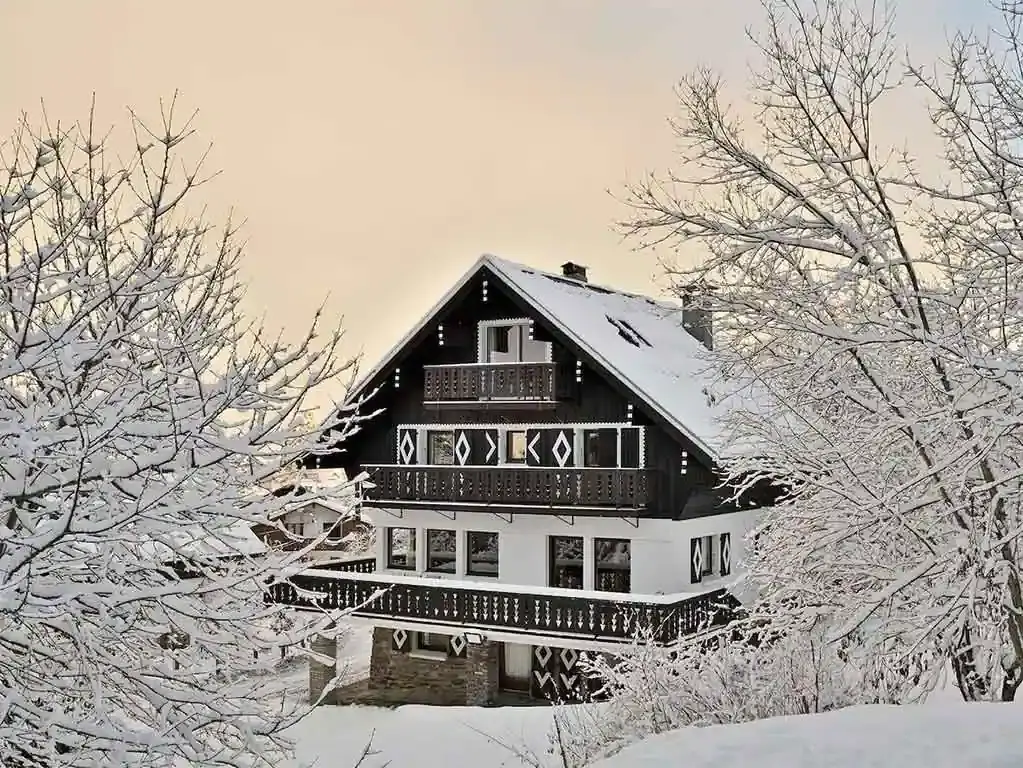
At just 28 years old, the architect received a decisive commission: Baroness Noémie de Rothschild wanted a pied-à-terre inspired by Savoyard farms, but capable of offering the comfort expected by an urban and international clientele. The chalet, begun in 1926 and completed in 1927, became the first major demonstration of his approach.
Rather than copying an old rural building, Henry Jacques Le Même reinterpreted its proportions, materials, and layout. He invented a residence specifically designed for winter sports and social life at the resort: the “skier’s chalet.”
The success of this first project was immediate. It opened the doors to a wealthy holidaymaking clientele and launched a career closely tied to the development of Megève.
What is the “skier’s chalet”?
The skier’s chalet is an architectural response to new ways of living. With the rise of winter sports, the chalet was no longer just an agricultural building used during the summer grazing season. It became a residence designed to accommodate families, guests, and staff in conditions comparable to those of an urban home.
Henry Jacques Le Même therefore paid great attention to the interior layout. Service areas, ski equipment storage, bedrooms, reception rooms, and circulation spaces were arranged according to their function. The chalet had to allow people to come in from the slopes, entertain guests, and stay comfortably without sacrificing the privacy of its occupants.
The living areas were placed at the center and opened more broadly onto the landscape. Windows, terraces, and balconies no longer served merely a decorative function: they made it possible to enjoy the light, the exposure, and the views of the surrounding mountain ranges.
The exterior architecture retained a connection to Savoyard buildings, but it was simplified and modernized. Stone, wood, and render were combined with cleaner lines, generous openings, and particular attention to proportions.
Architecture designed down to the smallest detail
Henry Jacques Le Même’s training with Ruhlmann is evident in his comprehensive approach to projects. He did not limit himself to designing façades or volumes. He also worked on staircases, fireplaces, light fixtures, handles, railings, furniture, and sometimes even decorative patterns.
Each chalet was custom-designed, based on its site, orientation, the lifestyle of its owners, and their habits. This pursuit of coherence sets his work apart from more standardized Alpine architecture.
Wood naturally plays an important role, without becoming a systematic decorative effect. Le Même knew how to combine it with stone, concrete, metal, color, and more urban finishes. He was already recognized in the 1930s for his mastery of timber construction, notably after designing the Savoy Pavilion and the Palais du Bois for the 1937 Paris International Exposition.
His architecture thus expresses a distinctive vision of luxury: one that lies not only in size or the accumulation of noble materials, but in the quality of proportions, the fluidity of use, and the precision of the details.
More than 200 chalets built in Megève
Henry Jacques Le Même quickly became one of the resort’s most sought-after architects. Over the course of his career, he designed more than 200 chalets in Megève, directly contributing to the creation of the village’s visual identity.
Among his most emblematic projects are La Croix-des-Perchets, Le Grizzly, and Le Cairn. These three chalets were awarded the “20th-Century Heritage” label, reflecting their importance in the history of Alpine architecture.
His influence, however, extends far beyond single-family homes. In Megève and throughout the Alps, Le Même also designed hotels, apartment buildings, shops, cafés, restaurants, sports facilities, and schools. He worked at every scale of the resort, from the interior design of a boutique to the design of public buildings.
This diversity helps explain why his work remains so closely associated with Megève: he did not merely design chalets, but helped shape a new way of living in the mountains.
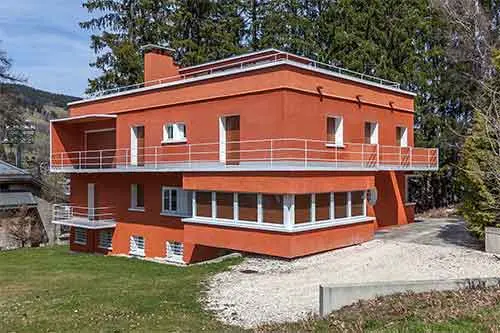
The house-studio, the architect’s personal manifesto
Between 1928 and 1929, Henry Jacques Le Même had his own house-studio built in Megève. There he brought together his home and his office in a building whose expression deliberately set itself apart from the holiday chalets he designed for his clients.
The house adopts a more openly modern vocabulary, in its volumes as well as in its materials and layout. It shows that Le Même did not regard the chalet as a style to be applied uniformly, but as a response to a specific program and way of life.
Henry Jacques Le Même worked and lived there for several decades. The house-studio was listed as a historic monument in 1995, during the architect’s lifetime.
A body of work that extends far beyond Megève
Although his name remains mainly associated with Megève, Henry Jacques Le Même developed a much broader body of work. Between the two world wars, he notably collaborated with architect Pol Abraham on the design of several sanatoriums on the Plateau d’Assy in Haute-Savoie.
These healthcare facilities imposed constraints very different from those of a private chalet: orientation, sunlight, ventilation, circulation, and constructive rationality became therapeutic elements in their own right. The projects completed in Passy are now considered benchmarks of modern architecture.
After the Second World War, Le Même also held roles linked to Reconstruction and designed many schools and public facilities in the Alps. His career thus reflects an ability to move from resort architecture to major collective programs.
Le Même chalets, a sought-after real-estate heritage
Today, the properties designed by Henry Jacques Le Même hold a special place in Megève’s real-estate heritage. Their value rests not only on their age or on the architect’s signature. It also lies in the quality of their design, their siting, and their contribution to the history of the resort.
A true Le Même chalet is recognized less by a fixed aesthetic formula than by a set of principles: adaptation to the terrain, functional organization, opening onto the landscape, careful circulation, and precise detailing.
Preserving these properties is nonetheless an important challenge. Contemporary expectations in terms of comfort, energy performance, and equipment can lead to major alterations. A successful renovation must therefore strike a balance between preserving the original architecture and integrating new uses.
The CAUE of Haute-Savoie notes that land pressure, changes in use, and compliance upgrades can lead to the transformation, or even the gradual disappearance, of certain notable 20th-century architectures. The municipality of Megève has also carried out an inventory of several hundred homes attributed to the architect in order to better identify this heritage.
A legacy still visible in Megève’s architecture
Henry Jacques Le Même died in 1997, after devoting most of his professional life to mountain architecture. Yet his influence remains visible in many contemporary projects.
Megève’s architectural vocabulary — the combination of wood, stone, and render, large reception rooms, openness to the landscape, and the pursuit of elegant comfort — owes much to his early experiments.
His legacy is not about reproducing identically the chalets built between the two world wars. Rather, it invites architects to understand the site, the uses, and their clients’ lifestyle before drawing. It is precisely this ability to reconcile local identity and modernity that explains the enduring presence of his work.
In Megève, Henry Jacques Le Même did not merely invent a type of chalet. He helped shape a way of life and gave the resort an architectural identity that has become inseparable from its international renown.
Discover luxury real estate in Megève
Character chalets, apartments in the heart of the village, renovated farmhouses, or contemporary properties: Michaël Zingraf Real Estate presents a selection of chalets for sale in Megève.

A lire aussi