



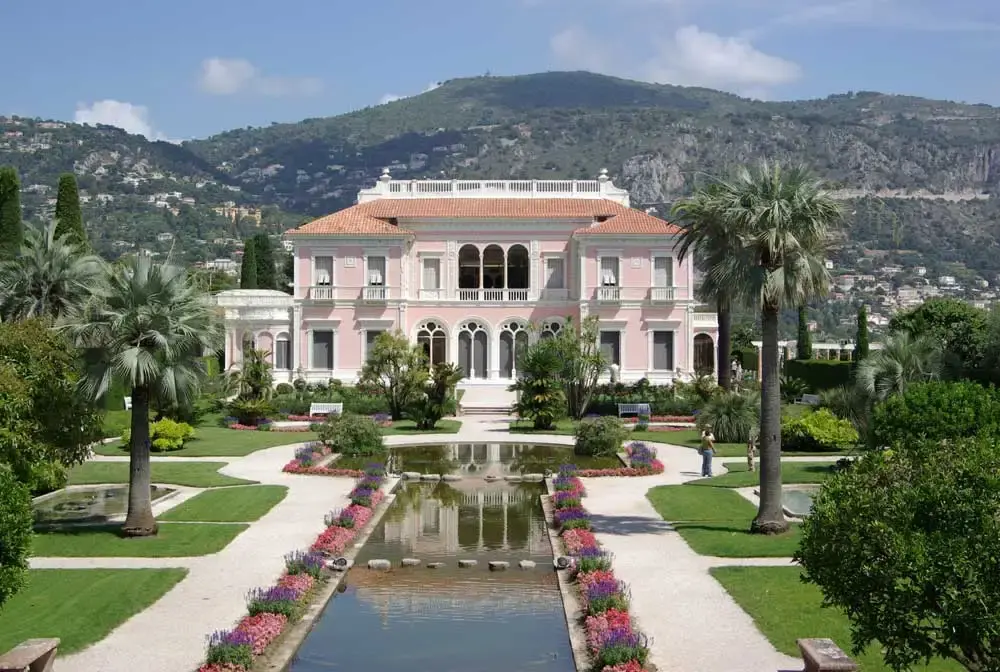
Built in the early 20th century for Baroness Béatrice Ephrussi de Rothschild, this exceptional residence bears witness to the artistic and architectural effervescence of the Belle Époque. Today, it houses a remarkable collection of furniture, paintings, tapestries, and porcelain, displayed at the heart of a seven-hectare estate.
An iconic villa of the Belle Époque
Béatrice Ephrussi de Rothschild’s project
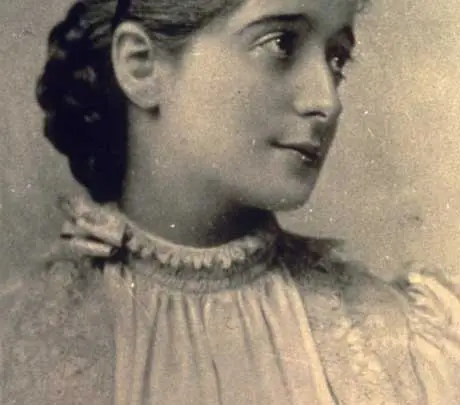
Born in 1864, Béatrice de Rothschild grew up in a family of collectors and patrons of the arts. The daughter of Baron Alphonse de Rothschild, regent of the Banque de France, she developed an early passion for the fine arts, antique furniture, and precious objects.
In 1905, captivated by the still-wild beauty of Cap Ferrat, she acquired a seven-hectare plot of land on the narrowest part of the peninsula. From this privileged location, the property enjoys open views over the sea, with the Bay of Villefranche to the west and the Bay of Beaulieu to the east.
Béatrice wanted to build a residence there capable of housing her collections while expressing her taste for Italian architecture, decorative arts, and gardens. Initially named Villa Île-de-France, the property owes its first name to an ocean liner associated with the memory of a particularly memorable voyage for the baroness.
A colossal construction project between 1907 and 1912
The creation of the estate was a true technical challenge. The rocky land had to be leveled and reshaped to accommodate the villa and its future gardens. Large quantities of earth were brought to the cap while certain parts of the ground were blasted.
Begun in 1907, work on the house was completed in 1912. Béatrice Ephrussi de Rothschild proved particularly demanding and consulted several architects before the project took its final form. Marcel Auburtin drew up the general plans, while Aaron Messiah played a decisive role in the execution and architectural evolution of the building.
The baroness then took up her winter quarters in the villa. She stayed there regularly for about ten years, dividing her time between Saint-Jean-Cap-Ferrat, Paris, Monaco, and Deauville.
An architecture inspired by the Italian Renaissance
The Villa Ephrussi de Rothschild draws its inspiration from the great palaces of Florence and Venice. The façades combine references to the Florentine Renaissance, Venetian architecture, and French aristocratic homes of the 18th century.
Yet this diversity of influences does not create any sense of disorder. The volumes, loggias, arcades, and columns form a balanced whole, widely open to the gardens and the Mediterranean.
Behind this historic appearance, the villa was equipped from the time of its construction with features that were particularly modern for its era: electricity, central heating, an elevator, and a telephone. Reinforced concrete was also used for certain façade decorations, making it possible to combine references to the past with contemporary construction techniques.
Listed as a Historic Monument together with its gardens, the property today stands as a major testament to the holiday architecture developed on the Riviera in the early 20th century.
Interiors designed for a collector
Inside, the villa reveals the personal world of Béatrice Ephrussi de Rothschild. The central patio, the grand salons, and the private apartments are arranged as showcases for her works and art objects.
The decoration follows what is sometimes described as the “Rothschild style”: a selection of the most remarkable pieces from different periods, brought together for their quality rather than for strict historical unity.
Visitors discover in particular furniture made by great cabinetmakers of the 17th and 18th centuries, tapestries, paintings, sculptures, Asian objects, as well as major collections of Sèvres, Saxon, and Meissen porcelain. Works or decorations associated with François Boucher, Tiepolo, Fragonard, and several European schools complete the ensemble.
The perspectives were designed to maintain a constant dialogue between the rooms, the gardens, and the sea. From several salons, the gaze thus passes through the interior spaces before extending toward the pools, terraces, and Mediterranean vegetation.
The nine gardens of Villa Ephrussi de Rothschild
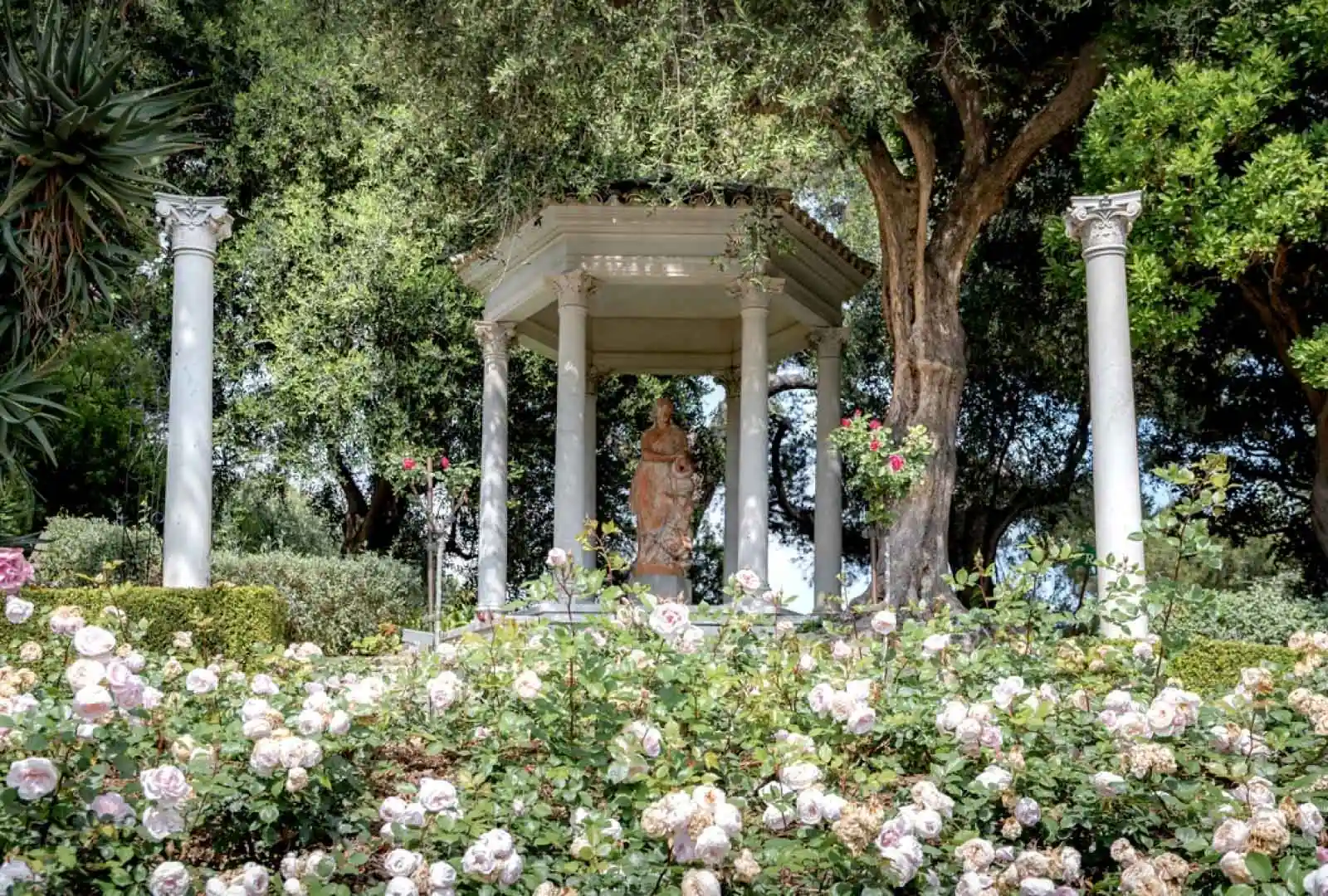
The villa is surrounded by nine themed gardens: the French garden, the Spanish garden, the Florentine garden, the Sèvres garden, the stone garden, the Japanese garden, the exotic garden, the Provençal garden, and the rose garden.
Their current layout is the result of several periods of development. Béatrice Ephrussi de Rothschild paid particular attention to the main garden and the estate’s grand perspectives. After her death, the landscape designer Louis Marchand developed and reorganized several themed gardens. Other areas were further transformed or restored during the 20th century and the early 21st century.
The French garden
Located directly in line with the villa, the French garden forms the estate’s main perspective. It is organized around lawns, pools, cascades, and a canal leading to the Temple of Love.
Béatrice imagined it as the deck of a ship. From the loggia, the sea appears on either side of the property, reinforcing the impression that the villa and its gardens are moving forward into the Mediterranean. Olive trees, cypresses, Aleppo pines, palms, and large vases inspired by the Italian Renaissance structure this composition.
The water features and fountains still set the pace of the walk today and fully contribute to the identity of the site.
The Spanish garden and the Florentine garden
The Spanish garden is a more intimate space, organized around a canal lined with vegetation. Jasmine, bougainvillea, honeysuckle, pomegranates, and fragrant plants evoke the patios and gardens of Andalusia.
Nearby, the Florentine garden is distinguished by its avenue of cypress trees and its horseshoe staircase. Its strict layout and sculptures recall the gardens of Tuscan villas from the Renaissance.
The stone garden
More shaded, the stone garden features architectural elements, bas-reliefs, and gargoyles from different periods. Set among undergrowth vegetation, these fragments create a mysterious space halfway between a romantic garden and an archaeological collection.
The Japanese garden
The current Japanese garden, called Cho-Seki-Tei, was created in 2003. Its name can be translated as the “garden where one quietly listens to the pleasant sound of the waves at dusk.”
It brings together different Japanese landscape traditions around dry, water, and mountain gardens. Rocks, pools, and vegetation create an atmosphere conducive to contemplation.The Exotic Garden and the Rose Garden
Formerly called the Mexican Garden, the Exotic Garden brings together a wide variety of succulents, cacti, aloes, and euphorbias. Severely damaged by the frost of 1985, it has since been rebuilt thanks to the addition of new plant collections.
The walk continues toward the rose garden, located at the far end of the estate. Old roses, modern varieties, climbing roses, and shrub roses bloom there facing the sea.
The Provençal Garden
The Provençal Garden showcases the characteristic species of the Mediterranean landscape. Olive trees, pines, mastic trees, rosemary, lavender, rockroses, and immortelles line its paths.
More natural than the gardens arranged around the villa, it recalls the original vegetation of Cap Ferrat and offers numerous openings onto the coastline.
From Private Residence to Museum
Before her death, Béatrice Ephrussi de Rothschild bequeathed the villa, its gardens, and all of her collections to the Académie des Beaux-Arts, in memory of her father Alphonse, who had been a member.
The bequest includes the seven-hectare estate as well as approximately 5,000 works and art objects from her various residences. The villa thus became a museum dedicated to preserving the spirit of a Belle Époque collector’s home.
The Villa Ephrussi de Rothschild is still the property of the Académie des Beaux-Arts, which resumed direct management in 2023.
Visiting the Villa Ephrussi de Rothschild
A visit to the villa and its gardens generally takes about two hours. However, a half-day allows visitors to enjoy the different areas, viewpoints, and the tea room located on the property at a more relaxed pace.
Audio guides in several languages are available. Online booking is recommended, especially during busy periods. Opening hours, admission prices, and any exceptional closures may change, so it is advisable to consult the official information before traveling.
How to get to the villa?
The Villa Ephrussi de Rothschild is located at 1 Avenue Ephrussi de Rothschild, in Saint-Jean-Cap-Ferrat, about ten kilometers from Nice and Monaco.
It can be reached by car via the Basse Corniche. Free parking is available on site, subject to availability.
By public transport, visitors can take bus line 15 to the “Passable – Rothschild” stop or line 607 to “Pont Saint-Jean.” From Beaulieu-sur-Mer station, it is also possible to continue on foot or by bus.
A Symbol of the Art of Living in Saint-Jean-Cap-Ferrat
The Villa Ephrussi de Rothschild is not only a historic monument. It also tells the story of Saint-Jean-Cap-Ferrat’s transformation into one of the Mediterranean’s most prestigious residential destinations.
Beginning in the Belle Époque, the peninsula attracted major European families, industrialists, artists, and collectors, drawn by its discretion, climate, and the beauty of its scenery. Many properties were then built in the heart of vast estates overlooking the bays of Villefranche and Beaulieu.
Through its location, architecture, and constant dialogue with the sea, the Villa Ephrussi de Rothschild still embodies this demanding vision of the art of living on the French Riviera: a blend of heritage, nature, elegance, and privacy.
A Must-See Visit on the French Riviera
Overlooking the Mediterranean from the heights of Saint-Jean-Cap-Ferrat, the Villa Ephrussi de Rothschild offers an immersion into the refined world of Béatrice Ephrussi de Rothschild and the great collectors of the Belle Époque.
Its salons, collections, and nine gardens allow visitors to journey through eras and artistic influences without leaving the peninsula. More than a century after its construction, the villa remains one of the finest examples of the architectural and landscaped heritage of the French Riviera.

A lire aussi